Mark Rubin
Jew of Oklahoma
Bold Americana Music from
"One of the great American Jewish musicians of our time."
- Weitzman National Museum of American Jewish History
Howdy! I'm releasing new music all the time
go to my bandcamp page and check it out

“Mark Rubin’s songwriting silences the superficial chatter, revealing myriad stories that tell just as much about his community as his role within it in the 21st century” - Dom Flemmons
"Mark is simply one of my very favorite all around fantastic and authentic real folk musicians!"
- Chris Strachwitz, Arhoolie Records
"One of North America’s most celebrated Jewish raconteurs" -Chutzpah Festival, Vancouver
" My favorite Do-Goodnik with a baseball bat." -Jerron Paxton
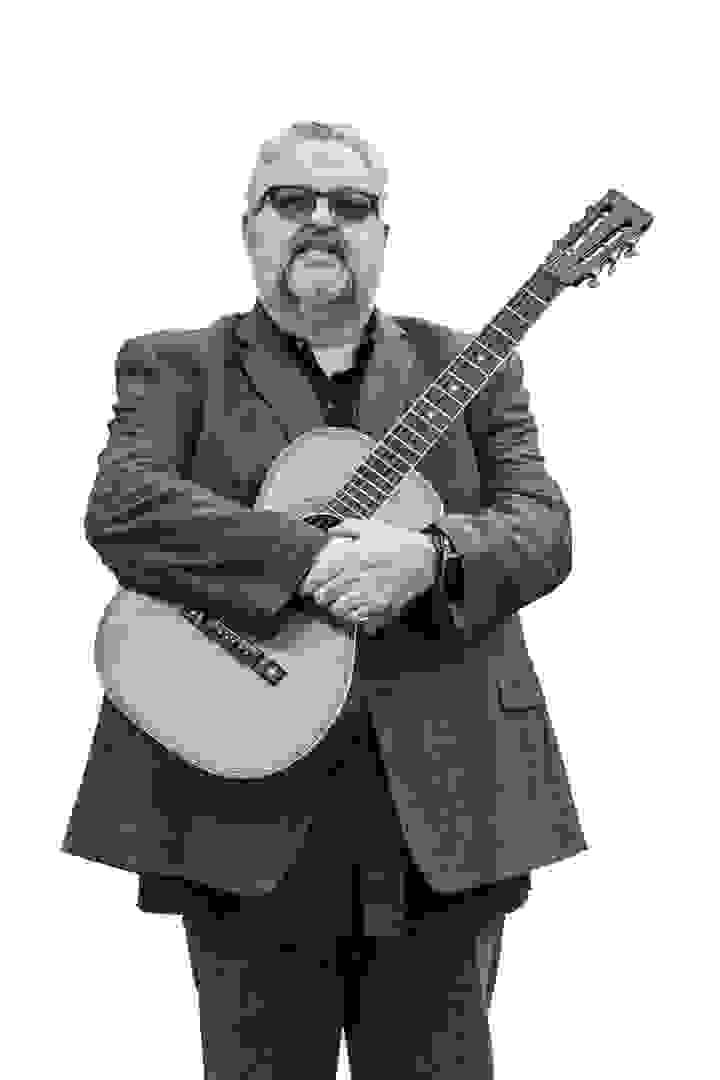
Mark Rubin is an internationally recognized multi-instrumentalist, songwriter, and cultural historian with over forty years of experience spanning American roots, country blues, punk, and contemporary Klezmer. A powerful socio-political storyteller, he pairs virtuosic clawhammer banjo and acoustic guitar with sharp-witted social commentary. Rubin is also an accomplished educator and speaker dedicated to exploring the intersections of heritage, identity, and regional music.
Born in Stillwater, Oklahoma, Rubin grew up in Norman, Oklahoma, where he was raised in a Jewishly observant household. His father served as the director of the Hillel Foundation at the University of Oklahoma. His first forays in music found him as a bassist in the local reggae band and a roadie for OKC's Flaming Lips. But Rubin’s early career took root in Texas. In 1987, he arrived in Dallas, where he became a founding member of Killbilly (1987–89), a band that famously blended the speed and energy of punk rock with traditional bluegrass. At the encouragement of banjoist Danny Barnes, Rubin moved to Austin. Together, they co-founded the legendary proto-Americana band the Bad Livers in 1990. As the band's bassist and tuba player, Rubin helped pioneer a genre-bending acoustic sound that heavily influenced a generation of alternative bluegrass and roots artists. (Bad Livers tunes feature regularly in Billy Strings setlists.)
For 13 years, he hosted the most popular late-night radio shift on Austin's premier public radio station, KUT 90.5 FM. Backed by his deep knowledge of vernacular music, his shifts became a destination for listeners seeking rare selections across country, blues, ethnic folk, and early jazz. In 1998 he served as a music producer, arranger, and session musician for director Richard Linklater’s 1920s Western caper The Newton Boys, helping shape the film's authentic ragtime and jazz-infused soundtrack and served as a music consultant and featured performer for the Truman Capote biopic Infamous (2006.) His production, arranging, and instrumental work extends into premium historical public television, notably providing soundtrack contributions for acclaimed PBS documentaries including the American Experience film George Wallace: Settin' the Woods on Fire (2000).
Rubin's musical deep curiousity lead to significant, multi-decade work as a core rhythm player within Texas' distinct immigrant communities. For years, he served as a trusted bassist for San Antonio conjunto legend and National Heritage Fellow Santiago Jimenez, Jr., touring heavily and anchoring the rhythm section and producing seminal recordings like the Grammy nominated Corazón de Piedra. Simultaneously, his mastery of the tuba and string bass made him a fixture in the historic dance halls of the Central and South Texas Czech and Polish communities, where he played traditional polkas and waltzes directly alongside rural community musicians to preserve a unique, localized European-Texan heritage.
This deep grounding in community-based ethnic music naturally translated to the international Yiddish music revival, where Rubin became a premier klezmer bassist and tuba player. For over three decades, he served on the faculty of KlezKamp, mentoring generations of musicians in traditional Yiddish folk arts. His driving, bedrock rhythm lines made him a first-call collaborator for the genre’s elite, including extensive touring and recording with Frank London's Klezmer Brass All-Stars, The Other Europeans, and clarinetist Andy Statman. Whether performing at major European cultural summits like Yiddish Summer Weimar and the Festival of Jewish Culture in Krakow, or leading his own Rubinchik's Yiddish Ensemble, Rubin’s work bridged old-world Eastern European traditions with a distinctly Texas swing.
After decades of anchoring legendary bands from behind, Rubin stepped forward as a solo frontman in 2015. The current chapter of Mark Rubin’s "Jew of Oklahoma" project finds the veteran multi-instrumentalist fully established as a fierce solo singer-songwriter, storyteller, and protest artist based in New Orleans. Shifting from his historic role as an ensemble bassist to a raw acoustic frontman, Rubin pairs driving clawhammer banjo and guitar with a songwriting style he calls "Southern Americana from a Jewish POV," a distinct approach heavily influenced by the plainspoken truths of country writer Harlan Howard and the resistance poetry of Yiddish writer Mordecai Gebirtig. This uncompromising artistic voice is anchors his latest solo albums, including 2021's critically acclaimed The Triumph of Assimilation, which confronted the cultural friction of the American South and debuted at #13 on the Billboard Bluegrass Chart, and 2025's Dispatches: Songs from a World Gone Mad, his most explicitly political collection to date.
Today, Rubin splits his time between active national touring—carrying his unvarnished narratives to intimate listening rooms, folk festivals like Folk Alliance International, and urban synagogues—and deep immersion in the South Louisiana music scene, where he plays tenor banjo with the Panorama Jazz Band and takes session dates as a premier klezmer tuba and bass player. When not on the road, he applies his deep historical knowledge to a supervisory role at New Orleans' Museum of the Southern Jewish Experience, where he jokes he's an "exhibit" himself.
Here's his Wiki page for more.
Mark plays Fraulini and Iris Guitars
Interested in the discussion?
Love to hear from you
texasrubinchik@gmail.com
(512) 659-8952
Publicity contact:
Brendan Gilmartin, Chartroom Media
brendan@chartroommedia.com
MEDIA:
Promo photo A
Promo photo B
Live Photos
Dispatches One Sheet
On "Dispatches: Songs from a World Gone Mad"
"Mark Rubin has an inconvenient propensity for saying what needs to be said, even when it is unfashionable, or in times like these when it is becoming increasingly dangerous to do so. The convergence of being unabashedly Jewish, unapologetically Southern, and unflinchingly pro-peace squeezes him into tight spaces, and still he reminds us that as long as he is living, there must in fact be space for him…a sentiment that all us folks on the fringes of a dominant monoculture could stand to lean into. “Dispatches” will remind you that living, breathing folk traditions of every ilk have wisdom and resilience embedded therein." - Lilli Lewis
Mark Rubin’s solo journey is a powerful artistic exploration of identity. He’s evolved from folk-tinged storytelling in Southern Discomfort, to more personal, folk-centric songwriting in Songs for the Hangman’s Daughter, culminating in The Triumph of Assimilation—a musically and thematically audacious work that bridged Yiddish cultural memory with Southern Americana.
"Dispatches: Songs from a World Gone Mad" (2025) will likely continue Rubin’s trajectory as an artist who challenges societal norms through his musical exploration of identity, politics, and personal narratives. This album could be viewed as Mark Rubin’s most political, with powerful songwriting, multi-layered arrangements, and keen social commentary. The album promises to be both a reflection of our present moment and a call for deeper engagement with the world around us.
Mark Rubin’s Dispatches: Songs from a World Gone Mad is a defiant, soulful howl against the chaos of the modern world. This album doesn't just observe the world—it confronts it head-on, charging at the heart of our most pressing issues with a blend of raw urgency, biting irony, and the kind of folk wisdom that only comes from a life deeply steeped in both Southern roots and Jewish heritage.
Released in 2025, this album marks a bold evolution in Rubin’s career, with his signature blend of Americana, bluegrass, klezmer, and protest music now fully unhinged and fueled by the intensifying contradictions of our time. The world is a mess, and Rubin is here to break it down, sing about it, and then offer a way out—even if that way is a little messy itself.
If Rubin’s earlier works questioned the tensions between his personal history and the larger social forces, Dispatches takes it to the next level. With tracks that feel like urgent dispatches from a world gone off the rails, the album confronts everything from global instability, political chaos, and social division, to climate collapse and rising antisemitism and nationalism.
But it’s not just a dark reflection. Rubin weaves in his trademark blend of hopeful defiance and sharp-witted irony, turning despair into fuel for action. His songwriting is a mash-up of scathing critique and poignant storytelling—no sugar coating here. Whether through his Southern Jewish lens or a raw portrayal of the everyday person’s fight for survival, Rubin’s voice cuts through the madness, reminding us that music can still be a weapon for change.
This album is Rubin’s most political work to date. It reflects the disillusionment of the modern era but pushes back against the hopelessness. With each track, Rubin challenges us to question the status quo, reflect on the world we’ve built, and consider how we might start repairing it. Through humor, heartache, and honesty, Rubin gives us an album that doesn’t just react to the madness—it adds to the conversation.
Each song feels like a musical dispatch, an urgent cry to listeners that things need to change, but they can change, and we have the power to change them. Rubin uses his platform to cut through the noise with his deep, introspective songwriting, ensuring that his message will be felt long after the record ends.
Critics will likely celebrate this album as a watershed moment in Rubin’s career. As both a musician and a social commentator, he captures the spirit of our times in a way that’s both personal and universal. Rubin’s ability to balance gritty realism with humor and compassion will make Dispatches: Songs from a World Gone Mad one of the standout albums of 2025—a musical protest, a personal reflection, and a clarion call for change all wrapped into one.
Dispatches: Songs from a World Gone Mad (2025) is Mark Rubin’s boldest album yet—a sonic rebellion against the madness of modern life. He melds his Southern Americana roots with Yiddish storytelling, and folk traditions creating a sound that is unmistakably his own. With its honest, passionate commentary on the political and social landscape, the album feels like a call to arms and an urgent reminder that while the world may have gone mad, we still have the power to fix it.
Amusing Jews with Jonathan Friedmann & Joey Angel-Field
(click image)
The Avrum Rosensweig Show
Art/Lab with rabbi josh rose
paradigms with Baruch Zeichner
(click image)

Reviews of my recorded work
On "The Triumph of Assimilation"
No Depression : Mark Rubin Explores Uneasy Borders of Jewish Identity and Southern Culture:
"There’s no better distillation of Jewish American identity couched in Southern culture than a 30-minute yarn seesawing between humor, horror, and rage relating to the ways the region’s legendary hospitality clangs with Jewish custom. For most Jews, “hostility” is the likelier word. For Mark Rubin, the Jew of Oklahoma himself, the luxury of just being plain old exasperated is welcome by comparison. ...In the South, Jews are acknowledged merely as Jews. Rubin’s radical argument is that maybe they should be treated as people."
American Songwriter: Mark Rubin’s ‘Triumph of Assimilation‘ Offers Upbeat Attitude with Humor and Optimism
"Ultimately, The Triumph of Assimilation comes across as an affable affair, albeit one that often comes across with a decidedly tongue-in-cheek approach, an amiable offering that’s flush with good natured intent. Consider this a triumph indeed."
Tablet Magazine : The Sounds of Summer
"Rubin not only has superb musical chops, honed over decades, but he’s clearly been thinking deeply about everywhere he’s been and everything he’s played. Sick of being told that he’s not Jewish enough for Northerners and not Christian American enough for Southerners, The Triumph of Assimilation is a musical manifesto, an electric declaration of being exactly enough, to hell with the haters."
"Mark Rubin is a legend from back in the alt country days, known for his pioneering work in the 90s with his band The Bad Livers in Austin. While he’s never left behind his earlier punk bonafides, his new work in recent years, billed as Mark Rubin - Jew of Oklahoma, has been more focused on the complexity of his identity as a Jewish person of Southern descent. With his new album, The Triumph of Assimilation, he masterfully melds old-school roots music with Yiddish protest songs and brutally acerbic ruminations on the long history of American anti-semitism."
"If an Okie Jew had a banjo and set his latest tune to a field-song arrangement, he’d very likely wind up with something like “It’s Burning"...It’s not what one might expect from a Jewish dude. But that’s the point of the track and the Triumph of Assimilation as whole."
On "Songs for the Hangman's Daughter"
"To live in New Orleans is to master the art of juggling.
On the one hand, that’s a great thing. Residents fighting to keep various food traditions from hitting the floor lead to the city’s famously blended culinary culture. On the other, you have a locale with terrible transit and neighborhoods that will flood if the faucet’s left on. You take the good with the bad, the bowling pins with the chainsaws, and you do your best to not make a mess of it.
With that said, it’s not surprising that Mark Rubin ended up here (NOLA.) It’s actually a wonder he didn’t land here sooner. The member of defunct folk-punk icons the Bad Livers is both outspokenly Southern and proudly Jewish. He’s been juggling all his life, y’all.
On his sparse new collection of tunes, Rubin doesn’t mind letting you see him sweat as he struggles to keep both sides of his identity balanced. The cuts are rough—often the first take—but Mark’s skilled playing and Catskills wit keep the whole enterprise aloft as he cycles between stories of cultural appropriation (“Royal Street Shuffle”), the War on Drugs (“Single Joint”) and parking lot fights (“Ballpeen Clawhammer”)." - Alex Galbreith
"Mark Rubin has created a masterpiece of American dark humor and grief. A bucket of personal history thrown into the wagons, mixed with the southern subterranean gravy of love and loathing. Since leaving Austin for New Orleans he has somehow managed to position himself as the Godzilla of Gypsy Juke N' Tuba Two-Step." -Kevin Russel (shinyribs)
“With Passover beginning tomorrow night, I can't think of a better time to listen to Mark Rubin's fabulous "The Dark Side Has Doughnuts" over and over and over again, along with all the other songs on his really remarkable (and often very funny) new album, "Songs for the Hangman's Daughter." It's the best singer-songwriter album I've heard in a very long time.”
- Michael Wex NYT Best Selling author
"The best way to be faithful to musical traditions is very rarely to go for the slavish copy. Slavish is never a good look. It invariably sounds like what it is, a copy of something. For my money, the artists who come closest to capturing what I love about old music are not the ones who have worked for years to get every note just right, to sound exactly like their examples, but the ones who seem to have an instinctive grasp of the energy of the music, of it’s heart, of what makes it special; those who have the ability to channel that understanding into the music they make. You can include Mark Rubin’s work in that category" - Lyons Recorder, Lyons CO, 2010